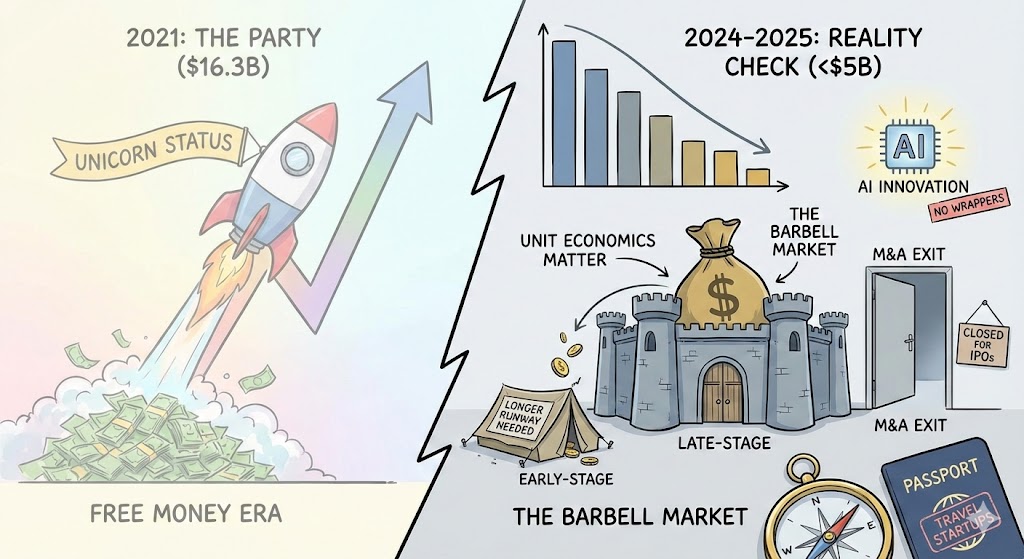
I’ve been diving into the latest numbers from Carta and Phocuswright, and if I had to summarize the current landscape in one sentence: The free money party of 2021 is officially over, and the hangover is real.
We are looking at a market correction that is less of a “dip” and more of a new baseline. As a travel investor, I see this not as a disaster, but as a return to sanity (painful sanity, but sanity nonetheless).
Funding: We Are Scraping the Bottom of the Barrel
Remember 2021? We hit a record high of $16.3 billion in funding. I think we all knew that was unsustainable, but the drop-off has been brutal.
The Reality: 2024 hovered around $5.8 billion, and projections for 2025 suggest we might dip below $5 billion.
The Context: That is a decade low. We are basically back to funding levels from before the word “unicorn” was in every pitch deck.
The “Barbell” Economy (Winner Takes All)
The volume of deals has fallen off a cliff. A decade ago, we saw nearly 1,000 funding rounds a year. Now? We are on pace for just over 200.
But here is the kicker: 83% of the total capital is going to just 6% of companies. If you are a late-stage company with massive revenue, checks are still being written. If you are an early-stage founder with a “cool idea” and a PowerPoint? Good luck. It’s a winner takes all environment, and the winners were decided yesterday.
What’s actually driving the checks that are being written?
Generative AI (The only shiny object left): If you can prove your AI isn’t just a wrapper (more on that below) and actually solves a friction point, like the “mind-reading” travel agent I’ve written about, you can still get a meeting.
Profit over Growth: The “growth at all costs” mantra is dead. Investors are asking about unit economics in the first meeting, not the third.
M&A is the new IPO: Nobody is ringing the bell at the NYSE. Mergers are the primary exit strategy now.
My Conclusions for Travel Startups (Or: How to Survive Until 2026)
Based on the data (and what I’m seeing in my own deal flow), here is the unvarnished truth for founders.
Your Runway Needs to Be Longer (Much Longer) The velocity of fundraising has slowed to a crawl. The median time between a Seed round and Series A used to be about a year. Now? It’s over 2 years. The Takeaway: If you raise a Seed round today thinking you’ll raise a Series A in 12 months, you’re going to run out of cash. You need 18–24 months of runway. Plan accordingly. Don’t assume the bridge round will be there to save you.
The “Traction” Bar Just Got Raised Investors are no longer funding “potential.” We need to see the engine working. The Takeaway: You need to hit higher ARR numbers earlier. A “good idea” doesn’t get you to Series A anymore; you need product-market fit that is screaming at you from the spreadsheets.
The “AI Wrapper” Trap I love AI (obviously), but there is massive skepticism around startups that are just thin wrappers around GPT-4. The Takeaway: If OpenAI releases an update next Tuesday that wipes out your entire business model, you are not investable. You need a moat: proprietary data, unique supply partnerships, or complex workflows that a generic LLM can’t easily replicate. I want to see your Travel LLM, not just you borrowing Sam Altman’s.
Swallow Your Pride on the Exit The IPO window is effectively painted shut for travel tech right now. The Takeaway: Stop viewing the legacy players (OTAs, hotel chains) solely as dinosaurs to be disrupted. They are likely your future buyers. Build relationships with their corp-dev teams early. A solid acquisition is a win; holding out for a unicorn valuation that never comes is a tragedy.
Sources: Phocuswright: The State of Travel Startup Funding (2025) PhocusWire: Travel Startup Funding & M&A Trends Q3 2025 Carta / WinSavvy: Data on Fundraising Timelines (Seed to Series A) Crunchbase: Global Funding Analysis 2024-2025