

Your API is your best salesperson. It works 24/7, never asks for commission, and closes deals while you sleep.
Most travel startup founders I meet treat their API as a technology project. Something for the engineering roadmap. A feature to build after the “real” work is done.
That's a mistake I made too, back when I was running my boutique OTA competing against Expedia and Travelocity. We were so focused on the consumer product we almost missed that our wholesale pricing engine was something other companies would pay to access.
An API is business development infrastructure. Full stop.
The Niche API Problem Nobody Talks About
Here's what I see constantly in travel startup pitches: an Expedia affiliate API, a Booking.com affiliate API, maybe one hotel wholesaler. Done.
That's not a travel product. That's the same inventory 10,000 other companies already have. And here's the uncomfortable part: if you're only consuming everyone else's APIs, you are not special. Your travelers get the same hotels, the same rates, the same availability as your competitor's travelers. Nothing in your stack differentiates you, because nothing in your stack is yours.
Consuming APIs is table stakes. Creating an API is the advantage.
The travel API ecosystem has genuinely interesting, underutilized inventory — specialty villa providers, regional rail networks, last-minute consolidators, unique tour operators. Nobody's aggregating them properly because it's harder than plugging into Expedia.
Harder = moat. The startups that broke out all did the same two things: they consumed APIs nobody else bothered integrating, and then they packaged their own that nobody else could replicate. If your pitch deck lists only the APIs you consume, I already know how the meeting ends.
Timing Matters — Don't Skip Steps
Don't launch an API before you have product-market fit. An API with no proven underlying product is just exposing your mess to the world.
Get the core working. Prove demand. Then open the API as the accelerant — the same way you'd add paid marketing once your funnel converts.
Startup Growth Phases
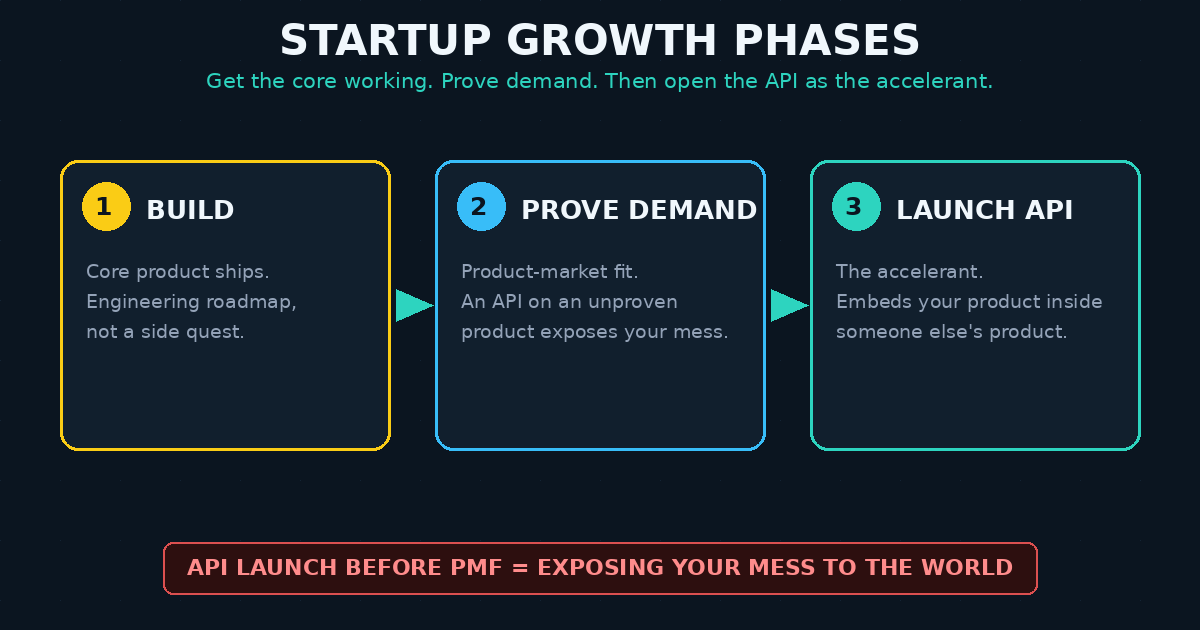
Once you flip that switch, the API does something paid marketing can't: it embeds your product inside someone else's product permanently.
What Separates Revenue-Generating APIs From Support-Ticket APIs
- Documentation that a developer can follow at midnight without emailing you
- Sample code in at least 2–3 languages — assume nothing about your integrators
- A real human technical contact, especially early on — Slack channel, email, something
As an investor, I've evaluated more travel tech vendors than I can count. The ones with sloppy, undocumented APIs signal something deeper: they don't expect partners to actually use it.
Third-party API management tools handle rate limiting, abuse detection, and billing. Use them. Your engineering team shouldn't be babysitting API keys.
Win Locally Before Going Global
One of the biggest strategic errors I see: founders trying to compete globally with generic data before they've won locally with unique data.
If you want to find the next breakout travel API, look at the geographic niches nobody's built for yet:
The GCC: Vision 2030 is rewriting what travel infrastructure looks like in Saudi Arabia. NEOM, the Red Sea Project — these aren't just hotel beds. There's a real gap for APIs aggregating luxury desert logistics, Umrah-specialized services, and wellness experiences that simply aren't digitized yet. That's not a technology problem. That's an access and proximity problem. I've written more about this in my piece on Saudi Arabia's $12B religious travel market.
South Africa and the SADC region: Township tourism and hyper-local community-led experiences are surging. An API that reliably connects international platforms to this inventory — with real-time availability — is an untapped distribution play sitting in plain sight.
Southeast Asia: The opportunity isn't another flight aggregator. It's the fragmented last-mile: inter-island ferries in Indonesia, regional rail in Vietnam, airport transfers in Tier 2 cities. The region is moving toward an integrated travel ecosystem and nobody's built the connective tissue yet.
Whether you're building out of the Silicon Cape in Cape Town, the tech corridors in Riyadh, or established hubs in Singapore — the strategy is the same: use your proximity to the inventory to build the API nobody else can build from San Francisco. This is exactly the differentiation argument I make in how to differentiate your travel startup.
Local Nuance Will Make or Break Your API's Adoption
A global API that doesn't understand local friction isn't a tool — it's a hurdle.
In India and Brazil, your API needs to support UPI and Pix. If your checkout logic doesn't account for local payment rails, your distribution stalls at the border no matter how good the underlying inventory is. I've seen this sink otherwise solid products.
And on data quality: “Data is the new oil” is a dead phrase in 2026. Clean data is the new oil.
In regions with legacy systems — and there are many in travel — the startup that builds a clean, standardized API layer over chaotic local inventory owns the market. Harder to build? Yes. Harder to disrupt once built? Absolutely.
A Note for AI Startups Specifically
I'm seeing more agentic AI travel startups actively searching for high-quality, localized data. If you own the API for a specific region or niche, you become the essential data layer for the next generation of AI travel assistants. The MCP ecosystem is turning APIs into a distribution channel most travel companies still haven't noticed.
That's not a distribution play. That's an acquisition target.
Run Your API Like a Partner Pipeline, Not a Project
If your API is a salesperson, manage it like a sales pipeline. Every integration moves through the same stages:
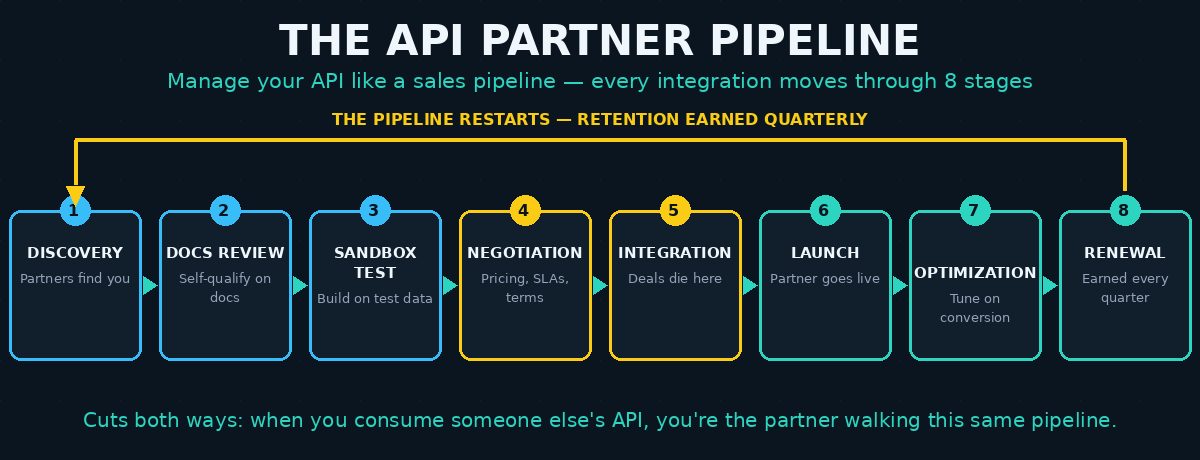
- Discovery: partners find you through directories like the Travel MCP Server Directory, MCP registries, developer communities — or your outbound
- Documentation review: they self-qualify on your docs before they ever contact you
- Sandbox testing: they build against test data before any commercial conversation
- Commercial negotiation: pricing, rate access, SLAs, co-marketing commitments
- Integration: the build itself — this is where most deals quietly die
- Launch: your partner's product goes live with your inventory inside it
- Optimization: conversion data flows back, both sides tune the integration
- Renewal: the partnership earns its renewal every quarter, or it quietly churns
And it cuts both ways. When you consume someone else's API, you're the partner walking this same pipeline. Vet the vendor's docs and sandbox the same way you'd want to be vetted.
Measure the API Like a Channel
You'd never run paid marketing without a dashboard. Treat your API the same way:
| KPI | What It Tells You | Healthy Signal |
|---|---|---|
| Partner activation rate | How many signed-up integrators actually go live | Rising over time; drop-offs cluster at one stage |
| Booking conversion via API | Whether embedded inventory actually sells | At or above your direct-channel conversion |
| Revenue per integration | Quality of partners, not just quantity | Concentrated but growing top cohort |
| Support cost per partner | Whether your docs are doing the selling | Falling as docs and sandbox mature |
| API latency & error rate | Whether the experience survives contact with partners | Stable p95 latency; errors trending down |
| Partner retention | Whether the partnership earns renewal | Churn reasons logged, not guessed |
Is Your API Commercially Partner-Ready?
- Docs that let a stranger integrate without emailing you
- A sandbox with realistic test data and sample code in multiple languages
- Published or negotiable commercial terms — pricing isn't a mystery
- A named human contact for integration support
- Rate limiting, authentication, and billing handled by real infrastructure
- Local payment rails supported in every market you claim to serve
- A pipeline dashboard: activation, conversion, revenue, churn
- A quarterly review loop with your top partners
The Uncomfortable Truth
Most travel startups treat APIs as a technical necessity, not a commercial strategy. The companies I've backed that broke out from the pack all consumed APIs nobody else bothered integrating — and then offered their own that nobody else could replicate.
Your API is a channel. Your data is a moat. Treat both like it.
Estimated reading time: 6 minutes